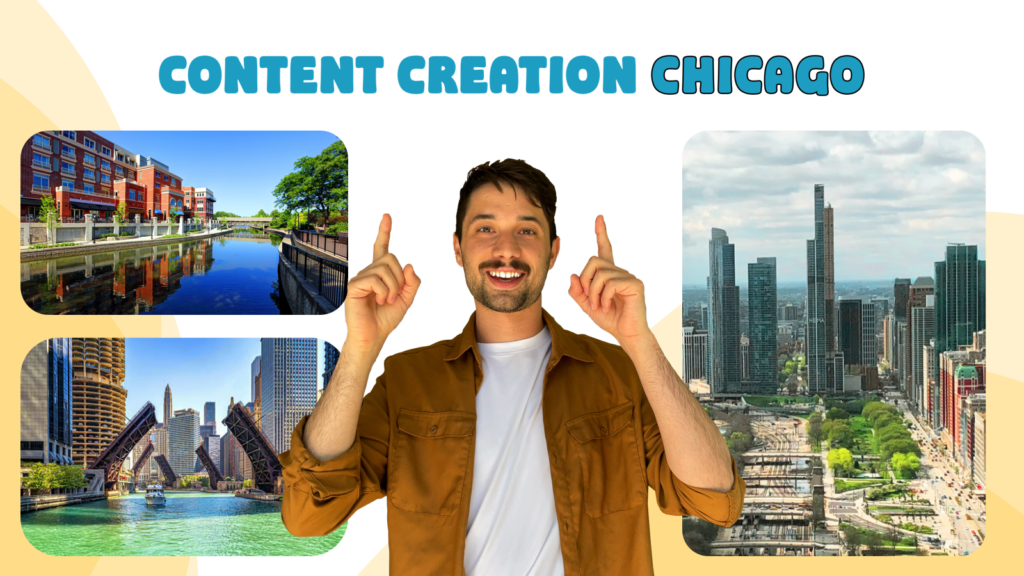
Chicago content creation for brand marketing means you want people to remember your brand, right?
Be everywhere.
I’m serious.
The brands that feel huge aren’t necessarily the brands you saw once. They’re the brands you see on Google, then Instagram, then another website, then again when you’re scrolling Facebook three days later.
You start thinking:
“I see these guys everywhere.”
That’s exactly the point.
My approach to Chicago content creation for brand marketing is built around creating that kind of visibility. We create a lot of content, publish consistently, and then pay for even MORE distribution to put the strongest content in front of the audiences we actually want to reach. But we’re not throwing money at every platform and hoping people notice us. No. Chicago content creation for brand marketing starts with research. There is a strategy behind being everywhere. It starts with keywords.
Brand Marketing Starts With Research
Before we start filming videos or throwing money into advertising, I want to know where your audience actually is. That’s where keyword and audience research comes in. We’re looking for things like:
- What is your audience searching for?
- How many people are searching?
- Where are they spending their time?
- What does it cost to reach them?
- How competitive are those audiences?
- What does Google Ads traffic cost?
- What does Meta advertising cost?
- Which topics are getting attention?
- What are your competitors doing?
This gives us something incredibly important: A realistic idea of what it’s going to cost to be visible. If we know approximately how much search traffic costs through Google Ads, how large our potential audiences are on Meta, and where organic search opportunities exist, we can make much smarter decisions about where the marketing budget should go.
I’m a big fan of being everywhere. I’m not a big fan of wasting money.
Scripting Before Content Creation
Once we understand the audience, we need something worth putting in front of them. This is where scripting comes in. Instead of turning on the camera and saying, “So… what should we talk about?”, we develop content around the strategy. That can include:
- Educational content
- Short-form videos
- Brand stories
- Service-focused content
- FAQs
- Customer problems
- Industry opinions
- Advertisements
- Testimonials
- Search-driven topics
- Offers and promotions
- Retargeting content
Different content has different jobs. Some content introduces your brand. Some answers a question. Some demonstrates expertise. Some addresses an objection. Some captures a Google search and addresses a keyword head on. Some helps someone compare their options. Some shows your personality. Some explains your process. Some sells. And some addresses that weirdly specific question your customer has been wondering about for three weeks but hasn’t asked anyone yet.
The goal isn’t to keep saying the same thing. The goal is to have something valuable to say about everything that matters to your audience.
Create More Content For Brand’s Organic and Paid Content
This is where I’m probably going to tell you something different from the person saying you should post twice a month so you don’t “overwhelm your audience.” Create more content. Not because we want to repeat ourselves. Because there are probably hundreds of conversations surrounding your business that you haven’t participated in yet.
One customer wants to know how much your service costs. Another wants to know how long it takes. Someone else wants to know whether it’s worth it. Another person is comparing you against an alternative. Someone has never heard of the solution you sell. Someone else knows exactly what they need and is looking for the best company to provide it. Those are completely different people with completely different thoughts.
Create content for all of them and stay on top of mind! Depending on how competitive your industry is, staying on top of mind is literally that branding is.
That could mean creating:
- Reels
- TikToks
- Blogs
- Graphics
- Carousels
- Website content
- Email content
- Google Ads
- Meta Ads
- Display advertising
- Downloadable resources
And one subject can have dozens of angles. You can answer the basic question. Then answer the advanced question. Talk about the cost. Talk about the mistake. Talk about the misconception. Talk about the alternative. Talk about the process.Talk about who it’s right for. Talk about who it’s NOT right for. Don’t just cover the topic. Own the conversation around it.
Publish More Content
Creating content and leaving it in a Google Drive folder doesn’t build a brand. We need distribution. And the more questions, searches, topics, and conversations we cover, the more opportunities we create for someone to encounter the brand. Someone might find your blog through Google. Someone else discovers a Reel. Another person sees a Meta ad. Someone researching your company lands on an FAQ. Another person downloads one of your resources. The point isn’t for every person to see every piece of content.
The point is to have the right piece of content available wherever and whenever someone needs it. That’s what being everywhere actually means. But organic publishing only gets us so far. Which brings us to paid distribution.
Pay for More Distribution
If we’re investing time and money into creating great content, I don’t want to cross my fingers and hope the algorithm distributes it. We can pay to get more of that content seen. And because we did our research first, we can make smarter decisions about where to spend and what to distribute.
Google Ads
Google Ads can put your business in front of people actively searching for products, services, problems, and topics related to your business. That’s powerful because we’re meeting people at the moment they’re asking the question. If they’re searching for something commercially valuable to your business, we can compete for that visibility.
Google Display Advertising
Display advertising gives us another way to extend the reach of the brand across websites and other digital properties. This can be particularly useful for awareness and retargeting. Someone might discover your company through one channel and encounter the brand again somewhere else as they continue researching. We’re creating more opportunities for the brand to be present throughout their decision-making process.
Meta Advertising
Meta is incredibly useful for visual communication. Facebook and Instagram allow us to distribute videos, images, testimonials, educational content, offers, and brand messaging directly into the feeds of relevant audiences. That’s especially valuable when what you sell needs to be seen, demonstrated, explained, or felt visually. And Meta also gives us opportunities to reach people based on how they’ve previously interacted with the brand.
Someone watched your video? Visited your website? Engaged with your content? Those interactions can help us develop smarter audiences and determine what we show them next.
Organic and Paid Content Should Work Together
I don’t like thinking about organic marketing and advertising as completely separate worlds. They’re distribution channels. A blog tells us people care about a topic? Make a video about it. A Reel generates tons of questions? Write the article answering them. A Google search keeps appearing? Build content around it. An advertisement gets an unusually strong response? There’s probably something in that message worth exploring organically. Your content should constantly give you ideas for more content. And your advertising should help you learn which messages deserve more distribution.
Branding and Content Creation Listens to Analytics
Here’s the fun part. People will tell us what they care about. Not necessarily by emailing us and saying, “Morgan, I particularly enjoyed Advertisement #7.”
They tell us through their behavior. We can look at:
- Impressions
- Reach
- Video views
- Engagement
- Clicks
- Search traffic
- Website sessions
- Conversions
- Cost per click
- Cost per lead
- Search queries
- Audience behavior
Then we start asking better questions. Which topics get attention? Which questions generate searches? Which videos hold attention? Which advertisements generate clicks? Which pages bring people deeper into the website? What content leads to conversions? What questions haven’t we answered yet? Where are we spending too much? Where should we spend more?
Then we adjust. Your first marketing strategy isn’t carved into a stone tablet.It’s a hypothesis. We research. We create. We distribute. We measure. We learn. Then we create the next round with more information than we had before.
The Brand Marketing Flywheel
Put everything together and the strategy looks like this:
Research → Script → Create → Publish → Advertise → Analyze → Adjust → Repeat
But each time we go around that cycle, we’re not simply repeating the same message. We’re expanding our coverage. We’re answering more questions. Covering more angles. Targeting more searches. Testing more ideas. Creating more entry points. Learning more about the audience. And identifying more opportunities to be seen.
Over time, you start building a massive library of content surrounding your business, services, expertise, and industry. That’s when the brand starts feeling like it’s everywhere.
Chicago Content Creation for Brand Marketing
The goal isn’t to publish the same message 100 times until somebody remembers your logo. The goal is much bigger. Answer every question, address every concern, and show up for the searches that matter.
Create for the platforms where your audience spends its time. Then use advertising to distribute that content even further. Show up on Google. Show up on Instagram. Show up on Facebook. Show up while they’re researching. Show up while they’re comparing. Show up when they’re finally ready to buy.
That’s my approach to Chicago content creation for brand marketing. Don’t just repeat yourself until people notice you. Create enough valuable content that you’re impossible to miss.
Chicago Born. Chicagoland Focused.
I’m from Chicago, and I work with businesses throughout Chicago and the surrounding suburbs to help them get seen online. Whether you need a new website, social media strategy, on-site filming and content creation, SEO, blogging, or digital advertising, I can help you build a stronger presence across Chicagoland. Chicago is home. Let’s make sure your business gets noticed here.
Error: Contact form not found.