If you work in social media long enough, you quickly realize that creating the content is only half the battle. You also have to figure out where it goes, when it goes live, who needs to approve it, and how you keep everything organized. I’ve worked in marketing for well over 15 years, and social media has been a huge part of that experience. Today, my team and I are juggling multiple content types, different platforms, blogs, videos, campaigns, and 40+ clients on a single publishing calendar. Needless to say, I’ve used my fair share of social media scheduling tools.
Some are unnecessarily complicated. Some are way too expensive for what they actually do. Others work perfectly well until you start managing a large amount of content. So, if you’re searching for the best social media scheduler, these are the three I would personally recommend based on what you actually need.
What Is a Social Media Scheduler?
A social media scheduler is a tool that allows you to create content in advance and schedule it to automatically publish to social media platforms such as Facebook, Instagram, LinkedIn, TikTok, Pinterest, and others. The biggest benefit is organization. Instead of remembering that you need to post something Tuesday at 10:00 AM, you can build your content ahead of time, put it on a calendar, and let the software handle publishing.
For a small business, that can save a few hours every month. For someone managing dozens of businesses like I do, a good social media scheduler is basically non-negotiable. But there’s a big difference between needing a simple scheduler and needing an entire content management system.
Here are my three recommendations.
#3: Buffer: Best Simple Social Media Scheduler
If you don’t need anything fancy, Buffer is a great place to start.
Buffer has been around for years and remains one of the easiest social media schedulers for beginners, solopreneurs, and small businesses. TechnologyAdvice currently recommends Buffer as its top beginner-friendly scheduling option, particularly because of its simple interface and straightforward calendar.
You can connect multiple social media channels, create your posts, schedule them, and see what’s coming up on your calendar without having to learn an overly complicated piece of software. Buffer currently supports platforms including Facebook, Instagram, LinkedIn, TikTok, Pinterest, Threads, X, YouTube, Google Business Profile, Bluesky, and more.
There is also a free option, which makes Buffer particularly attractive if you’re just getting started.
Who do I recommend Buffer for?
Someone managing their own business or a small number of social media profiles who simply wants to stop manually publishing everything. You don’t necessarily need an enormous marketing platform. You just need something that makes posting consistently easier. That’s where Buffer makes sense.
#2: SocialPilot: Best Affordable Social Media Scheduler
My second recommendation is SocialPilot. The best way I can describe SocialPilot is: it’s cheap, it works, and it gives you the features you actually need. Want a calendar where you can see your upcoming posts and move content around? Here it is. Want to add another user without spending hundreds of dollars? Here it is. Want to manage multiple social media accounts without buying an enormous enterprise marketing platform? You get the idea.
SocialPilot’s Essentials plan currently starts at $17 per month when billed annually, while its Standard plan includes 10 social accounts and three users. Additional users on applicable plans can be added for $5 per month. It also includes features such as a social media calendar, analytics, bulk scheduling, team collaboration, content libraries, and AI tools depending on your plan.
For small marketing teams, freelancers, and businesses managing several accounts, SocialPilot provides a lot of bang for your buck. It isn’t necessarily the most powerful content marketing platform I’ve used, though.
That brings me to my number one pick…
#1: StoryChief: My Favorite Social Media Scheduler
StoryChief is my personal favorite, and it’s what I use when I need something far more robust than a traditional social media scheduler. The easiest way to explain the difference is that StoryChief isn’t really just a social media scheduler. It’s a SEO and content marketing hub.
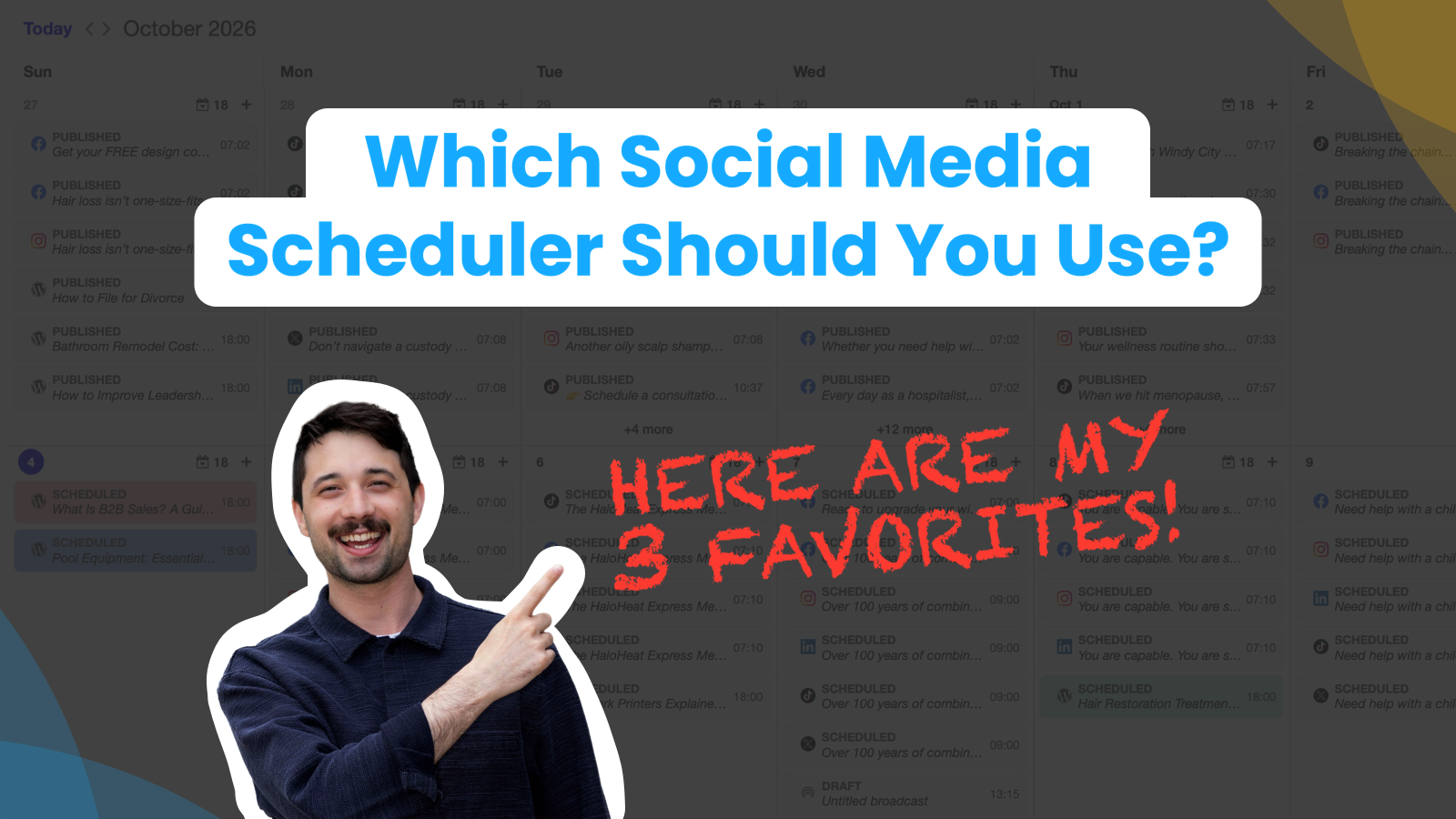
Take a look at the screenshot below.
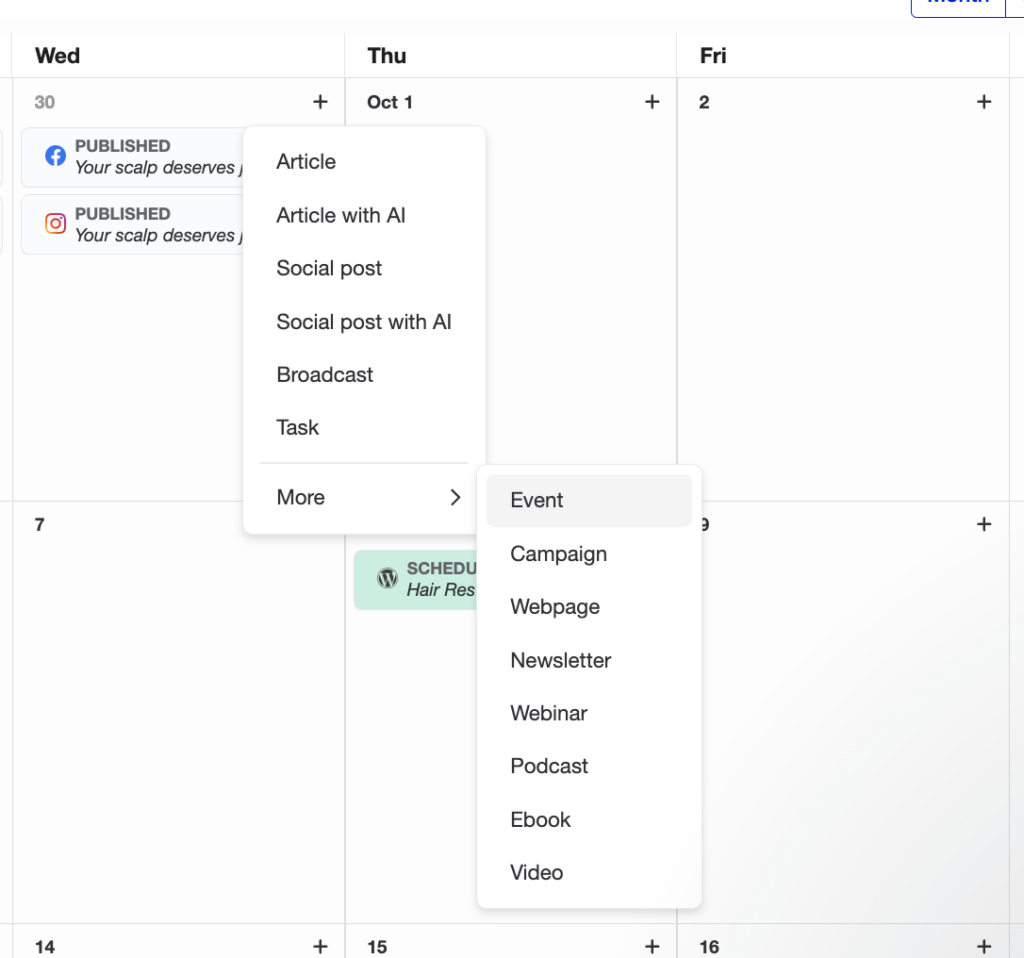
From the same calendar, I can create and organize articles, social posts, broadcasts, tasks, events, campaigns, webpages, newsletters, webinars, podcasts, ebooks, and videos. StoryChief’s current platform supports planning many of these different content formats from one calendar. That is incredibly valuable when your marketing strategy extends beyond Instagram and Facebook.
StoryChief Connects More Than Just Social Media
This is probably the biggest reason StoryChief gets my #1 spot. I can connect social platforms including Instagram, Facebook, LinkedIn, TikTok, Threads, Bluesky, YouTube Shorts, Pinterest, X, and Google Business Profile. But I can also connect websites and content management systems.
StoryChief currently integrates with platforms such as WordPress, Webflow, HubSpot, Shopify, Drupal, Contentful, Ghost, and others. It can also distribute content through Medium, Dev.to and RSS feeds, while integrating with email platforms including Mailchimp, Campaign Monitor, and ActiveCampaign.
That’s a HUGE difference. If I create a blog article, for example, I can manage the article and its promotion within the same content ecosystem rather than constantly jumping between five different programs.
StoryChief Is Also Fantastic for Agencies
Here’s another feature I absolutely love as someone managing a large number of clients. I can give each client their own individualized calendar link. They don’t have to dig through everybody else’s content, and they don’t even necessarily need their own StoryChief account. StoryChief allows you to create filtered calendar views and share them through a public link. Anything matching that client’s filters can automatically appear in their shared calendar. StoryChief
That means Client A sees Client A’s content.
Client B sees Client B’s content.
Nobody gets their wires crossed.
When you’re managing 40+ businesses, something seemingly that simple makes an enormous difference. I also have to give StoryChief credit for its support. In my experience, their team has consistently been responsive when I need technical assistance or have questions. I’m often connected different websites, social media APIs, and more. Each time the support team has been there to assist me. When your entire publishing workflow depends on a piece of software, having reliable support matters.
Which Social Media Scheduler Should You Use?
The answer really depends on how much content you’re managing. If you’re a small business owner who wants a simple way to schedule posts ahead of time, start with Buffer. If you’re a freelancer, small agency, or growing team that wants more functionality without spending a fortune, I’d look at SocialPilot. But if you’re managing a complete content strategy involving social media, blogs, websites, videos, campaigns, client approvals, and multiple businesses, StoryChief is my recommendation.
I’ve spent more than 15 years working in marketing, and if there’s one thing I’ve learned, it’s that your tools should make your job easier, not give you another job to do. A good social media scheduler does exactly that. And when you’re juggling dozens of clients and hundreds of pieces of content, having everything organized in one place isn’t just convenient.
It’s how you keep your sanity.